
Posted by Kelley Bazydlo
We are happy to announce that the UPDATED Call for Papers for ASOR’s 2010 Annual Meeting is now on ASOR’s web site and includes new Member-Organized Sessions that have just been approved by the Program Committee. This year’s meeting will be held at the Sheraton Atlanta Hotel in Atlanta, Georgia from November 17-20, and you can find full information about registration, travel, and accommodations on ASOR’s web site. We encourage you to register for the meeting and to book your rooms today!
The Program Committee has worked hard to develop a diverse offering of sessions. For those who would like to present papers, make sure to review the “List of Sessions for 2010” and begin submitting your abstracts for review and inclusion in the 2010 Annual Meeting. We are also happy to announce that we are launching a new online system for Abstract/Participation Submissions. You can access this new online system by clicking here. The deadline for submission of abstracts is February 15, 2010.
On behalf of Elise A. Friedland and Andrew M. Smith II, Program Committee Co-Chairs, I thank you for considering becoming a part of the academic program. Please do not hesitate to contact me should you have any questions or comments. I look forward to seeing you this November in Atlanta.
New Orleans is the birthplace of the cocktail, and ASOR members know much about hepastocapy. So when you need a break from meetings and papers, here are a few famous places within walking distance to kill a few brain cells.
- Get a sazerac at the newly reopened Sazerac Bar at the Roosevelt Hotel (123 Baronne Street, 504-648-1200).
- Get a Pimm’s cup at the Napoleon House (500 Chartres Street, 504-524-9752).
- Take a spin with a Vieux Carre cocktail at the Carousel Bar at the Hotel Monteleon (214 Rue Royale, 866-338-4684).
- Try a rum based drink at Lafitte’s Blacksmith Shop, the oldest bar in America. Then come back to the meeting and talk like a pirate (941 Bourbon Street, 504-522-9377).
- Get a a mint julep, or better yet, a Davenportini, while listening to Jeremy Davenport at the Ritz-Carlton on Thursday from 5:30-9PM or Friday/Saturday from 9PM on (921 Canal Street, 504-524-1331)
- Get an absinthe frappe at Tujagues’s saloon (823 Decatur, 504-525-8676).
- Conjure the ghosts of Frank Sinatra, Jean Lafitte, and Mark Twain with a ramos gin fizz at the Old Absinthe House (240 Bourbon Street, 504-523-3181).
- They have over 100 types of martinis at the Bombay Club (830 Conti Street, 504-586-0972).
- Join the other tourists by the fire fountain for a hurricane at Pat O’Briens (718 St Peter).
- There are several cocktail walking tours. The Original Cocktail Tour is a good one. So is the Southern Comfort Walking Cocktail Tour. The Museum of the American Cocktail is at the Riverwalk Mall which is also near out hotel (504-569-0405).
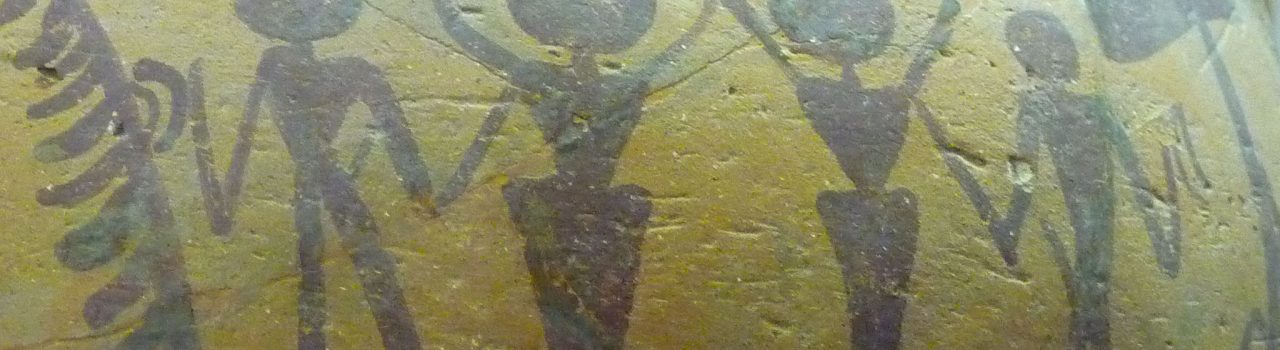
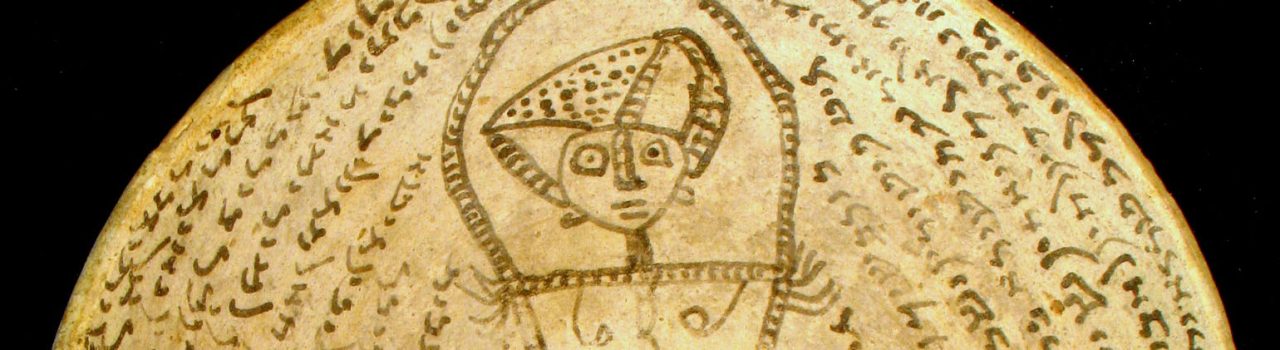
On Saturday, November 21st, from 6-8 PM, the American Schools of Oriental Research will close out its annual meeting in New Orleans with an outreach session entitled “Voodoo Dolls of the Ancient Near East.” It’s free and open to the public, including our friends in town for the Society of Biblical Literature annual meeting. The session will be somewhere inside the Astor Crown hotel at the corner of Canal and Bourbon. Here’s the lineup:
Michael M. Homan (Xavier University of Louisiana), Presiding
Sallie Ann Glassman (Island of Salvation Botanica/La Source Ancienne Ounfou), “Vodou Spirits and
Sacred Vodou Flags” (20 min.)
Gary O. Rollefson (Whitman College), “The Glory Belongs to Our Ancestors: The Neolithic ‘Ain
Ghazal Statues and Plastered Skulls” (20 min.)
Christopher A. Faraone (Univeristy of Chicago), “Voodoo Dolls in the Greek and Roman Worlds: An
Update” (20 min.)
Sara A. Rich (Catholic University, Leuven), “Manipulated Miniatures: Haitian and Mesopotamian
Figurines Defy Human Destiny” (20 min.)
William G. Dever (University of Arizona, Emeritus), “The Judean Pillar-base Figurines: Mothers or
Mother-Goddesses?” (20 min.)
Shawna Dolansky (Northeastern University), “Re-Figuring ‘Fertility’ Figurines: Fetishistic Functions of
the Feminine Form” (20 min.)

For more information, please email Michael Homan.
Posted by Michael Homan
On Wednesday, November 18th, from 9:00 AM – 2:00 PM, members of the American Schools of Oriental Research will be volunteering at Holt Cemetery in Mid-City New Orleans.

Graves at Holt Cemetery on a rainy day in Mid-City New Orleans.
We will be working with
Save Our Cemeteries to record the current condition of Holt Cemetery. This includes surveying individual graves and their markers, along with taking photos in order to establish a record of the current state of the cemetery. The data we collect will then be compared to photos taken prior to the 2005 levee failures and can serve for future restoration work.

R.I.P. A.B. Hyman
Unlike other cemeteries in New Orleans where the dead are housed in above ground vaults, the remains of the deceased at Holt Cemetery are buried below ground. The graves are often marked with simple markers, such as writing on bricks or pieces of wood.
This “potter’s field” cemetery was established in 1879 as a place of interment for the city’s impoverished, and it is named after Dr. Joseph Holt, who was a member of the New Orleans board of health.

Buddy Bolden Grave Marker
Perhaps the biggest mystery surrounding Holt Cemetery involves the location of it’s most famous burial: jazz pioneer Buddy Bolden, credited by many as the individual most responsible for this great American invention. Bolden was buried in plot C-623, though records of the location of C-623 have long been lost.
Thus far 14 members of ASOR have signed up, and if you are interested in joining us please email Kelley Bazydlo. (Note: you do not need to be a member of ASOR to volunteer).
You can see more photographs of Holt Cemetery taken today in this Flickr set. Also, if your hotel is already booked for check in on November 18th, ASOR members who are interested in volunteering are more than welcome to stay at my house the night of November 17th. I’m located within walking distance from Holt Cemetery and the street car line which will take you to the Astor Crowne hotel in plenty of time for the opening session. Write to me here.
Contributed by Tristan Barako, Ph.D., Senior Researcher, Providence Pictures
When The Bible’s Buried Secrets premiered on PBS this past November, it was NOVA’s most watched show in the past five years, attesting to the enduring interest that biblical archaeology holds for the general public. The two-hour special was produced by Providence Pictures, where I now work as senior researcher and writer. The president/producer/director of Providence Pictures, Gary Glassman, took the unusual step of hiring me—someone with absolutely no prior experience in film production—on the strength of my background in archaeology and biblical studies. He and NOVA wanted to make sure that the film was as accurate as possible. To that end we enlisted the support of more than 30 ASOR members, who generously gave of their knowledge and granted us complete film access to their excavations and artifacts. Through their participation and the collective effort of all our staff and crew, we’ve shown that a documentary about biblical archaeology can be both a popular and scholarly success.
To give the readers of this blog some sense of the filmmaking process, here are a few behind-the-scenes peeks of the challenges we faced while making The Bible’s Buried Secrets. Most of what follows relates to my uncredited cameo appearances. In the interest of full disclosure, it must be said that Michael Homan, the moderator of the ASOR blog, also appears in the film. It was originally a more substantial role—his big line went something like “Ron, you better come down here; we just found something that’s going to make your day!” —but that part of the scene, unfortunately, ended up on the cutting room floor.
A reenactment of the discovery of the Tel Zayit abecedary.
Idol smasher: The climax of the destruction of Hazor was a close-up, slow motion shot of a statue of a seated male being decapitated. We had originally planned to shoot this scene in Israel, so we had our Art Director there, Gal Oren, make three replicas of the statue, but we ran out of time so we had to do it in the U.S. instead. The location we ended up using was Gary’s garage in Providence, where we clamped the statue (made of plaster, not the original basalt) to a low table and positioned a Duraflame stick in front of the camera. Then we smoked up the garage and I put on a robe, dirtied up my arm and hand, and grabbed the mallet. I was a bit nervous because I wanted to make sure that the head came off cleanly, similar to how the original was found at Hazor. To stay in the frame I had to approach the statue at an odd angle, but this did not get in the way of a near perfect strike: the head flew off and crashed against the back wall. Good thing, because I shattered the next two replicas.
Smashing idols in Gary’s garage.
German scholar: This was my most challenging role given the amount of time on camera and the task at hand—channeling Julius Wellhausen. To prepare for it we bought a nineteenth-century German Bible and rented a three-piece suit from a costume company in California (surprisingly we couldn’t find anything on the east coast). I also let my beard grow out a little. Finally, I found a section in my Biblia Hebraica Stuttgartensia that contained clear J and E passages. Despite all these preparations we overlooked something, as pointed out to me by a friend who is a German historian: the wedding band was on my left hand, whereas Germans typically wear it on the right. There goes the Emmy for best research.
Playing Julius Wellhausen
Gila’s assistant: In this scene, a recreation of the discovery of the Tel Dan Stela, I played only a supporting role: the guy holding the stadia rod for Gila Cook who found this famous inscription in 1993. We followed her recollection of events throughout, which included loading her up like a pack mule, while I ambled off the tell empty-handed. I felt especially insensitive because she was battling laryngitis that day and we made her go up and down the hill with all that equipment a few times on multiple takes, but she was a real trooper and the scene turned out beautifully.
Loading up Gila
Dead Israelite: We used Nazareth Village for many recreations including the scene where one of the Jerusalem priests rescues scrolls from a building set aflame by the Babylonians. Again I donned a robe and got smudged up, but this time all I had to do was lay sprawled out in the background. I’m really not visible because of all the smoke. Our Director of Photography, Nick Gardner, inhaled so much of it that he woke up that night with a splitting headache.
Tristan as a dead Israelite
YHWH: In one of the many scribal scenes, we wanted an extreme close-up of someone writing the personal name of the Israelite god, YHWH. Most of our recreation actors were modern-day sopherim, whom we casted for their ability to write Torah scrolls. The problem was, though, they refused to write the divine name. I volunteered to do it, but I write left-handed and all our scribes were righties. So we pressed into service our thoroughly secular, dread-locked soundman, Amir Liani, who did a great job considering that it was his first time writing in paleo-Hebrew.
YWHW in Paleo-Hebrew
For more information about Providence Pictures and The Bible’s Buried Secrets, including additional behind-the-scenes features, visit:
www.providencepictures.com and www.pbs.org/wgbh/nova/bible.
Contributed by Kelley Bazydlo
We are happy to announce that the Call for Papers and Sessions for ASOR’s 2009 Annual Meeting is now on ASOR’s web site (link). This year’s meeting will be held at the Astor Crowne Plaza in New Orleans from November 18-21, and you can find full information about registration, travel, and accommodations on ASOR’s web site (link). We encourage you all to pre-register and book your rooms today.
The Annual Program Committee has worked hard to develop a diverse offering of sessions. We are still able and eager to accommodate some new sessions, so if you have a new session that you would like to propose, please do so. The deadline for new session proposals is Friday, February 6, 2009. For those who would like to present papers, make sure to review the “List of Sessions for 2009” (check again after February 15 for newly approved sessions that will be posted then) and begin submitting your abstracts for review and inclusion in the 2009 annual meeting. The deadline for submission of abstracts is Sunday, March 1, 2009.
On behalf of Elise A. Friedland and Andrew M. Smith II, this year’s Program Committee Co-Chairs, I thank you for considering becoming a part of the academic program. Please do not hesitate to contact me (asormtgs@bu.edu) should you have any questions or comments. I look forward to seeing you this November in New Orleans.