
Thomas Verenna: History’s ‘The Bible’ in Broader Contexts

By: Thomas Verenna

This entry is reblogged from The Musings of Thomas Verenna. You can find the original entry here and his other posts on The Bible series here.


In lieu of writing a much longer piece for an online journal, I have thought it useful to open up some to a conversation concerning the History Channel’s ‘The Bible’. Recently lots has been made about the inaccuracies of the miniseries, as well as Glenn Beck’s (racist?) comments about how similar is their Satan character to “that guy”. But not much has been said in its defense.

This is problematic; while there are inaccuracies, I am not sure that it diminishes from the quality or historical contexts that are present. Before Jim West gets flustered (don’t hate me Jim), let me explain my meaning.

As students of the past, there is one constant fact to all of our ancient literature that I’m sure many of my readers will already know: they contain elements of what some would call ‘truth’ (in a philosophical or theological sense), elements of cultural memory/social memory (historical or otherwise), and lots more mythological constructs–fictions, to be blunt about it. In the Gospels, this is probably the most clear-cut. We have four canonical Gospels and dozens of noncanonical Gospels, some contain similar elements between each other (Matthew and Luke contain something like 90% of Mark’s Gospel with their own additional, unique content). Continue reading

Wil Gafney: History Channel’s Satan and President Obama

By: Wil Gafney, Associate Professor of Hebrew and Old Testament at The Lutheran Theological Seminary at Philadelphia.

This entry is reblogged from Dr. Wil Gafney’s blog. You can find the original entry here and Dr. Gafney’s other posts on The Bible series here.


Many viewers of the History Channel’s Bible mini-series saw and see a resemblance between the character of Satan and President Barack Obama. Comparison photos such as the one above are circulating on Facebook, Twitter and other social media platforms. The History Channel denies any resemblance and any attempt to pattern the character after the President.

Whether one sees a resemblance or not, the History Channel has produced a biblical epic with virtually no actors from contemporary corollaries of biblical lands, so the North African (Moroccan) actor Mohamen Mehdi Ouzaani is highly visible as Satan in a production where the Israelites are portrayed by white actors. I have previously addressed the use of race in the series here and here and here. The History Channel is responsible for what it broadcasts just as the producers, Mark Burnett and Roma Downey, and their casting agents are responsible for the product they produce. Continue reading

Mark Goodacre: The Bible Series — Drama and Historical Context

By: Mark Goodacre, Associate Professor of Religion at Duke University

This entry is reblogged from NT Blog. You can find the original entry here and Dr. Goodacre’s other posts on The Bible series here.


March 21, 2013

While I realize that the only thing people seem to want to talk about at the moment in connection with The Bible Series is the alleged resemblance between a still of Mohamen Mehdi Ouazanni and President Obama, I will risk talking about several other features of the most recent installment of the drama, which was broadcast in Sunday evening on History Channel.  Here is a recap of the episode (courtesy of the History Channel website):

One of the aspects that I appreciate in the New Testament episodes of The Bible series is the attention paid to historical context.  One of the challenges for film-makers on this kind of project is to provide some explanation of the historical context without weighing the narrative down with turgid exposition. I talked about this a little in relation to BBC’s The Passion in 2008 in a piece that also found its way onto the DVD, “The Passion” and Its Historical Context. Continue reading

The Talpiot Tomb and the Beatles

By: Mark Goodacre, Dept of Religion, Duke University

The current discussion of Talpiot Tomb B, the “patio tomb”, has largely centered on the interpretation of the picture on one of the ossuaries.  But Tabor’s and Jacobovici’s argument that this tomb is linked with Jesus and his disciples is related to their earlier claims about Talpiot Tomb A, the “garden tomb”.  The case that this is the Jesus family tomb was made in 2007 in a book, a film and a website.[i]  It was largely based on a claim about statistics — this cluster of names, bearing so close a relationship to the names of members of Jesus’ family, was most unlikely to have occurred by accident. Continue reading

A Reply from Prof. Tabor—A Jonah Fish Image or a Tower Tomb Monument?

James D. Tabor, University of North Carolina at Charlotte

 I want to thank ASOR’s executive director Andy Vaughn, guest editors Eric Meyers and Christopher Rollston, and participating colleagues, for devoting time and space to a special consideration of the ideas expressed in the non-specialist book, The Jesus Discovery as well as the more technical paper I have published at the web site The Bible and Interpretation, “A Preliminary Report of an Exploration of a Sealed 1st Century Tomb in East Talpiot, Jerusalem” during the month of March. Whether damned or praised—and so far there has been much more of the former than the latter—it is an honor to have ones ideas considered by colleagues. Continue reading

Jodi Magness responds to the “New Jesus Discovery”

Professor Jodi Magness
Department of Religious Studies, University of North Carolina at Chapel Hill

As usual, the arrival of the Easter season this year is heralded by a sensational archaeological claim relating to Jesus. In March 2007, we learned from a TV documentary and accompanying book that the tomb of Jesus and his family had been discovered in Jerusalem’s Talpiyot neighborhood. The producer was undeterred by the fact that not a single archaeologist – including the tomb’s excavator – supported this claim (for my comments see http://www.archaeological.org/news/279; also see Eric Meyers’ response to the current claim). Now the same producer has identified remains of early Christian followers of Jesus in a tomb nearby. What is the basis for this new claim? Photos taken by a robotic arm that was inserted into the tomb supposedly show a graffito depicting a whale incised on an ossuary, and an inscription containing the Tetragrammaton and the word “arise” or “resurrection.”

Continue reading

Reflections of an Epigrapher on Talpiyot Tombs A and B: A Detailed Response to the Claims of Professor James Tabor and Filmmaker Simcha Jacobovici

Professor Christopher A. Rollston (crollston@ecs.edu) Professor of Semitic Studies, Emmanuel Christian Seminary

I. THE CLAIMS OF TABOR AND JACOBOVICI: THE NEW BOOK[1]

Here are the basic claims of James Tabor and Simcha Jacobovici: “Talpiyot Tomb B contained several ossuaries, or bone boxes, two of which were carved with an iconic image and a Greek inscription.  Taken together, the image and the inscription constitute the earliest archaeological evidence of faith in Jesus’ resurrection.”  They go on and state that these ossuaries “also provide the first evidence in Jerusalem of the people who would later be called ‘Christians.’  In fact, it is possible, maybe even likely, that whoever was buried in this tomb knew Jesus and heard him preach.” Continue reading

Brief Reflections of an Epigrapher on Talpiyot Tombs A and B

Professor Christopher A. Rollston, Emmanuel Christian Seminary

Much can, and no doubt will, be said about the proposal (and new volume) of Professor James Tabor and Filmmaker Simcha Jacobovici that Jesus of Nazareth was married to a woman of Magdala named Mary, that they had a son named “Judas” and that their tomb has been found in East Talpiyot (Jerusalem).  Of course, this all started several years ago with the same individuals proposing the same basic thing about a tomb dubbed “Talpiyot Tomb A.”  Recently, these same scholars investigated a tomb that they have dubbed “Talpiyot Tomb B,” and they believe that this new tomb demonstrates the veracity of their previous conclusions. Continue reading

NEA 73.1 available online via Atypon Link

Near Eastern Archaeology 73.1

ASOR is pleased to announce that NEA 73.1 (March 2010) has now been posted online at Atypon Link.

The issue contains a feature article by A. Burke and K. Lords as well as articles S. Savage, A. Al-Shorman, C. Luckey, and K. Rask.

You may access the table of contents here:

http://www.atypon-link.com/ASOR/toc/nea/73/1

As a reminder, the last 3+ years of ASOR journals are available to ASOR members on Atypon Link. For details, please see the following URL:

http://www.asor.org/updates/atypon-online.html

Secrets of The Bible’s Buried Secrets

Contributed by Tristan Barako, Ph.D., Senior Researcher, Providence Pictures

When The Bible’s Buried Secrets premiered on PBS this past November, it was NOVA’s most watched show in the past five years, attesting to the enduring interest that biblical archaeology holds for the general public. The two-hour special was produced by Providence Pictures, where I now work as senior researcher and writer. The president/producer/director of Providence Pictures, Gary Glassman, took the unusual step of hiring me –”someone with absolutely no prior experience in film production –on the strength of my background in archaeology and biblical studies. He and NOVA wanted to make sure that the film was as accurate as possible. To that end we enlisted the support of more than 30 ASOR members, who generously gave of their knowledge and granted us complete film access to their excavations and artifacts. Through their participation and the collective effort of all our staff and crew, we’ve shown that a documentary about biblical archaeology can be both a popular and scholarly success.

To give the readers of this blog some sense of the filmmaking process, here are a few behind-the-scenes peeks of the challenges we faced while making The Bible’s Buried Secrets. Most of what follows relates to my uncredited cameo appearances. In the interest of full disclosure, it must be said that Michael Homan, the moderator of the ASOR blog, also appears in the film. It was originally a more substantial role, his big line went something like “Ron, you better come down here; we just found something that’s going to make your day!”but that part of the scene, unfortunately, ended up on the cutting room floor.


A reenactment of the discovery of the Tel Zayit abecedary.

Idol smasher: The climax of the destruction of Hazor was a close-up, slow motion shot of a statue of a seated male being decapitated. We had originally planned to shoot this scene in Israel, so we had our Art Director there, Gal Oren, make three replicas of the statue, but we ran out of time so we had to do it in the U.S. instead. The location we ended up using was Gary’s garage in Providence, where we clamped the statue (made of plaster, not the original basalt) to a low table and positioned a Duraflame stick in front of the camera. Then we smoked up the garage and I put on a robe, dirtied up my arm and hand, and grabbed the mallet. I was a bit nervous because I wanted to make sure that the head came off cleanly, similar to how the original was found at Hazor. To stay in the frame I had to approach the statue at an odd angle, but this did not get in the way of a near perfect strike: the head flew off and crashed against the back wall. Good thing, because I shattered the next two replicas.


Smashing idols in Gary’s garage.

German scholar: This was my most challenging role given the amount of time on camera and the task at hand — channeling Julius Wellhausen. To prepare for it we bought a nineteenth-century German Bible and rented a three-piece suit from a costume company in California (surprisingly we couldn’t find anything on the east coast). I also let my beard grow out a little. Finally, I found a section in my Biblia Hebraica Stuttgartensia that contained clear J and E passages. Despite all these preparations we overlooked something, as pointed out to me by a friend who is a German historian: the wedding band was on my left hand, whereas Germans typically wear it on the right. There goes the Emmy for best research.


Playing Julius Wellhausen

Gila’s assistant: In this scene, a recreation of the discovery of the Tel Dan Stela, I played only a supporting role: the guy holding the stadia rod for Gila Cook who found this famous inscription in 1993. We followed her recollection of events throughout, which included loading her up like a pack mule, while I ambled off the tell empty-handed. I felt especially insensitive because she was battling laryngitis that day and we made her go up and down the hill with all that equipment a few times on multiple takes, but she was a real trooper and the scene turned out beautifully.


Loading up Gila

Dead Israelite: We used Nazareth Village for many recreations including the scene where one of the Jerusalem priests rescues scrolls from a building set aflame by the Babylonians. Again I donned a robe and got smudged up, but this time all I had to do was lay sprawled out in the background. I’m really not visible because of all the smoke. Our Director of Photography, Nick Gardner, inhaled so much of it that he woke up that night with a splitting headache.


Tristan as a dead Israelite

YHWH: In one of the many scribal scenes, we wanted an extreme close-up of someone writing the personal name of the Israelite god, YHWH. Most of our recreation actors were modern-day sopherim, whom we casted for their ability to write Torah scrolls. The problem was, though, they refused to write the divine name. I volunteered to do it, but I write left-handed and all our scribes were righties. So we pressed into service our thoroughly secular, dread-locked soundman, Amir Liani, who did a great job considering that it was his first time writing in paleo-Hebrew.


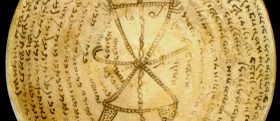
YWHW in Paleo-Hebrew

For more information about Providence Pictures and The Bible’s Buried Secrets, including additional behind-the-scenes features, visit:

www.providencepictures.com and www.pbs.org/wgbh/nova/bible.

Archaeologists and Journalists: Please Stop Finding the Garden of Eden!

Contributed by Michael M. Homan, Xavier University of Louisiana.

I just read that they found the Garden of Eden again. It seems to have moved from its previous locations in Bahrain, Yemen, Iraq, Saudi Arabia, and Jerusalem. The latest location of chez Adam & Eve is at Gobekli Tepe. While it is truly an amazing site with great implications for understanding the Neolithic Revolution, it’s not Paradise.

So why the skepticism? Simply put, the story of the Garden of Eden is a myth.

The Center Panel (Paradise) of the Garden of Earthly Delights by Hieronymous Bosch

The Center Panel (Paradise) of the Garden of Earthly Delights by Hieronymous Bosch

The Bible offers a couple of clues about the location of Eden. Cain was kicked out of Eden eastward to Nod (Gen 4:16). However, ‘Nod’ is derived from a root that means “to wander,” so it’s not a specific location, but indicates that Cain will be a fugitive. The best evidence for Eden’s location is that a river in Eden broke into four rivers: 1) the Pishon, 2) Gihon, 3) Hiddekel, and 4) Ferat (Gen 2:10-14). The identity of the last two is certain, being the Tigris and Euphrates respectively. Nevertheless, a wide range of possibilities for the other two prohibits a definitive location. The river Pishon is said to be located in the land of Havilah where there is quality gold, bdellium and onyx stone (2:11-12). Havilah is alternatively located in 1) Nubia, with the Pishon being the Nile, 2) India, with river candidates being the Indus or Ganges, or 3) Southwest Arabia, with the Pishon being the Wadi Bisha and the Wadi Baish. All three areas are famous for gold and the other commodities. Similar confusion surrounds the identification of the Gihon River. Gihon comes from a root meaning “to gush forth,” and thus it is a common name for flowing bodies of water throughout the ancient Near East. The Bible qualifies Eden’s Gihon as a river that flows around the land of Cush (2:13). Confusion persists, however, as there are in fact two areas named Cush in the Bible, the first and more famous being Nubia, and thus the Gihon would refer to the Nile River. The second area for biblical Cush is in Midian, with a number of wadis and streams serving as candidates. The great biblical scholar and archaeologist William Albright thought that the Pishon and Gihon were the two branches of the Nile River, known today as the Blue Nile and the White Nile. Alternatively, some have claimed this River Gihon is the famous spring in Jerusalem’s Kidron Valley, thus linking the Garden of Eden to the Temple in Jerusalem. Nevertheless, this remains unlikely, as the argument ignores the correspondence of Eden’s Gihon to the land of Cush, a term never used in conjunction with Jerusalem. The early Jewish Historian Josephus identified the Pishon with the Ganges and the Gihon with the Nile. In doing so, Eden is positioned at the source of the ancient Near East’s four largest rivers. Thus, it’s not a realistic location that you could visit, but instead, it is a mythological place which brings fertility in the form of river water to the entire world known to the biblical authors.

And to close here is Marge Simpson’s dream about Eden, but sadly, it cuts off before the butterscotch pond and the porno bush:

Adrift Again on Noah’s Ark

Contributed by Eric Cline.

Mea culpa. For more than a week now, I have remained silent, simply rolling my eyes amid news reports that Randall Price is going in search of Noah’s Ark this coming summer (www.foxnews.com/story/0,2933,486684,00.html; dated 2 Feb 2009). Eighteen months ago, in Sept 2007, I published an op-ed in the Boston Globe which, in part, chastised my fellow archaeologists for not deigning to comment on such stories, or the outlandish claims that usually come from such expeditions upon their return (www.boston.com/news/globe/ideas/articles/2007/09/30/raiders_of_the_faux_ark/; dated 30 September 2007). And yet here I have been for eight days, sitting on my hands with my mouth clamped firmly shut, doing nothing.

Noah's Ark Resting on top of Mt. Ararat. A note to the naive and gullible: this image was photoshopped.

Noah\’s Ark Resting on top of Mt. Ararat. A note to the naive and gullible: this image was photoshopped.

But I’m not alone. In fact, only one archaeologist has spoken out so far (though to be fair, the non-archaeologist “˜biblioblogger” Jim West did draw attention to the story on February 1st [jwest.wordpress.com/2009/02/01/oh-and-price-is-also-looking-for-noahs-ark/]). Robert Cargill, of UCLA, posted comments on his Facebook page a few days ago: “’tis the season for pseudoscientific fundamentalists to venture out into the world and attempt to prove things that are sure to yield no results, lots of press, and raise lots of dollars in the process.” Amen, Brother Cargill. I couldn’t have phrased it better myself.

Price is the newly-appointed executive director of the Center for Judaic Studies, which opened in Fall 2008 at Jerry Falwell’s Liberty University. He has a Master of Theology degree in Old Testament and Semitic Languages from Dallas Theological Seminary and a Ph.D. in Middle Eastern Studies from the University of Texas at Austin. He is also the founder and President of the World of the Bible Ministries, whose stated goal is “to provide service to the Christian community by clarifying biblical truth through an increased understanding of the original context of the Bible which is Israel and the Middle East” (www.worldofthebible.com, last accessed on 10 February 2009). Their website also states: “We believe in the total verbal, plenary, unlimited, and inerrant inspiration of Scripture (Old and [sic: missing word; probably New] Testaments), and in it’s [sic] complete sufficiency and authority for faith and practice” (www.worldofthebible.com/message.htm, last accessed on 10 February 2009). (By the way, is it just me or does anyone else inherently mistrust a website with grammatical mistakes and missing words? Can’t they afford a proofreader?) Continue reading