

Archaeology Weekly Roundup! 12-7-12

Croesus brooch

The original, left, and the fake golden brooch in the shape of a winged seahorse

Since being illegally excavated in the 1960s, King Croesus’s golden brooch has been stolen, replaced by a fake, sold to pay off gambling debts and has allegedly brought down a curse on its plunderers.

As part of a repair job 3,300 years in the making, Harvard’s Semitic Museum is seeking to undo some of the destruction wrought when Assyrians smashed the ancient city of Nuzi in modern-day Iraq, looting the temple and destroying artifacts. They’re using 3-D modeling to restore a smashed lion statue. Continue reading

ASOR Campaign Announced

school fundraising ideas

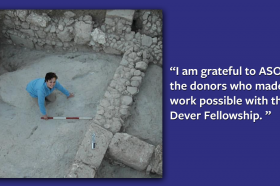
The “Building a Foundation for ASOR Campaign” has been one of ASOR’s worst kept secrets over the past twelve months. This $1.3 million brief yet vital initiative need not be a “secret” any longer. We are pleased to report that ASOR has passed the halfway mark of our campaign goal, and this milestone was announced by ASOR President Tim Harrison at the Thursday night reception at the Oriental Institute during the 2012 ASOR Annual Meeting in Chicago.

The campaign was officially launched with a unanimous vote by the ASOR board at the 2011 Annual Meeting in San Francisco. The primary goals of the first phase of the campaign were to expand ASOR’s donor base, while concurrently seeking to reach the halfway mark of $650,000 in gifts and pledges by the 2012 Annual Meeting in Chicago. We are pleased therefore to be able to announce that the campaign has met and exceeded both of these goals! We set a new record last year with 282 different donor—equivalent to almost 1 in 5 ASOR members—who made a charitable contribution, and we have received $670,000 in gifts and pledges toward the campaign! Moreover, by the time the Annual Meeting had ended in Chicago, we were above $700,000. With the public announcement of the campaign, we have now set our sights on meeting the $1.3 million goal by June 30, 2014 (the end of Fiscal Year 2014). Any gifts made to ASOR for the annual fund, scholarships, or any other program or area, will count towards our campaign goal. The following is a summary of the case statement for the Foundational Campaign. Continue reading

Archaeology Weekly Roundup! 11-30-12

There are easier places to make wine than the spectacular, desolate landscapes of southeast Turkey, but DNA analysis suggests it is here that Stone Age farmers first domesticated the wine grape.

Harvard professor Jason Ur has launched a five-year archaeological project in Iraq—the first such Harvard-led endeavor in the war-torn nation since the early 1930s—to scour a 3,200-square-kilometer area around Irbil, the capital of the Kurdish region in northern Iraq, for signs of ancient cities and towns, canals, and roads. Continue reading

Archaeology Weekly Roundup 11-9-12

masada israelIsraeli paleographer Ada Yardeni has recently identified 50 Dead Sea scrolls found near Qumran in Israel as having been penned by the same scribe, a scribe who also penned scrolls that have been found at the Herodian mountain-top fortress of Masada, where Jewish rebel zealots made their last suicidal stand against the Romans in 73 A.D.

New techniques reveal that the settlement of Polynesia first occurred within a 16 year window nearly 3000 years ago. The research, published November 7 in the open access journal PLOS ONE by David Burley and colleagues from Simon Fraser University, Canada, dates coral tools and reveals that the first human settlers lived in a founder colony on the islands of Tonga between 2830 to 2846 years ago. Continue reading

Archaeology Weekly Roundup! 10-19-12

Assyriancourtesy-ezinemark.comArchaeologists working in northern Iraq have discovered a new Assyrian site in the vicinity of the historic Arbil city center, the head of the antiquities office in the Kurdish Province of Arbil, Haydar Hassan, was quoted as saying in an Iraqi newspaper.

The Egyptian city of Alexandria, home to one of the seven wonders of the ancient world, may have been built to align with the rising sun on the day of Alexander the Great’s birth, a new study finds. Continue reading

Archaeology Weekly Roundup!

Madain Saleh, Saudi Arabia (AFP/File, Hassan Ammar)

Dating back to the second century BC, the Nabataean archaeological site, also known as Madain Saleh, has long been hidden from foreign visitors in this ultra-conservative kingdom that rarely opens up to tourists. But now the largest and best preserved site of the Nabataean civilisation south of Petra in Jordan is the first Saudi archaeological site to be inscribed on UNESCO’s World Heritage List and increasingly seeing tourists.

Around 2,100 years ago, at a time when Egypt was ruled by a dynasty of Greek kings, a young wealthy man from Thebes was nearing the end of his life. Rather than age, he  may have succumbed to a sinus infection caused by a mouthful of cavities and other tooth ailments. Continue reading

Archaeology Weekly Roundup

  Fire swept through the old central souk, or marketplace, of Aleppo, Syria, damaging a vast and well-preserved labyrinth of medieval storehouses, shops, schools and ornate courtyards as fierce clashes between security forces and insurgents vowing to carry out a “decisive battle” for the city continued.

An Austrian museum says skeletal remains found in an ancient, Bronze Age grave are that of a woman metal worker — the first indication that women did such work thousands of years ago.

The results of scientific tests using replicas of two ancient Egyptian artificial toes, including one that was found on the foot of a mummy, suggest that they’re likely to be the world’s first prosthetic body parts. Continue reading

Protecting Archaeological Sites in Conflict Zones: What Is to be Done in Syria?

By: Lawrence Rothfield

The recent upsurge in high profile news stories, in Time and other mass media outlets, about the looting of archaeological sites in Syria has been accompanied by the usual public handwringing by archaeologists and heritage protection organizations. The terrible impact on the world’s cultural patrimony is bewailed, and the heads of UNESCO, the World Monuments Fund, and so on call upon the international community to stop the destruction. What is most depressing, for those of us who study the history of cultural heritage protection in times of armed conflict, is how similar these public statements are to those made in the runup to and the wake of the 2003 invasion of Iraq. Thousands of looting pits pockmarking Iraq bear witness to how ineffectual those earlier pronouncements were, and yet the archaeological and heritage community continues to issue them.

Continue reading

Archaeology Weekly Roundup!

The damaged outer gate of Aleppo’s Citadel (Nelofer Pazira)

The ongoing civil war in Syria, a land brimming with history, has led to a dangerous, tragic surge in the looting and smuggling of Syrian antiquities, and the trade of antiquities for guns.

A Harvard professor has identified what appears to be a scrap of fourth century Egyptian papyrus that contains the first known explicit reference to Jesus as married, a discovery that could fuel the millennia-old debate about priestly celibacy in the Catholic church. But the papyrus has no context and many scholars are already arguing it is fake. Continue reading

Archaeology Weekly Roundup!

 Israeli archaeologists digging on the route of a planned highway have found new ruins from a 1,500-year-old Jewish town, the Israel Antiquities Authority said.

A Byzantine period baptistery structure has been unearthed at one of the most important ancient sites in Kosovo by Turkish archaeologists. It is the first international excavation to be carried out by Turkish archaeologists in Europe. Continue reading

Archaeology Weekly Roundup!

Archaeologists have discovered a large public cistern from the time of the First Temple in Jerusalem’s Old City, the Israel Antiquities Authority said Thursday, offering new insight into the city’s water supply more than 2,500 years ago.

Mexican anthropologists and archaeologists have occupied Mexico’s prestigious National Museum of Anthropology to protest what they see as the misuse and destruction of sites throughout the country.

Continue reading

Archaeology Weekly Roundup!

Two ancient animal figurines from the Pre-Pottery Neolithic B, one in the image of a ram and the second a wild bovine, have been discovered in excavations near Jerusalem.

British archaeologists are hoping to find the lost grave of King Richard III under a Leicester car park, which they believe was once the site of a church where the medieval monarch was buried more than 500 years ago. Continue reading

Archaeology Weekly Roundup!

Burial image from Firth (1912) The Archaeological Survey of Nubia. Report for 1908-1909. Image: The University of Manchester

A two and a half year transatlantic search by researchers at The University of Manchester for the remains of thousands of Nubian skeletons excavated by George Reisner more then a century ago will culminate in a fascinating workshop later this month.

Google is expanding its Street View offerings to include dozens of 360-degree photo tours of ancient Mexican monuments such as Teotihuacan, Chichen Itza and Palenque. Continue reading

Archaeology Roundup!

Photo: Alaa Al-Marjani, Associated Press / SF

A hundred yards or so from taxiing airliners, Iraqi archaeologist Ali al-Fatli is showing a visitor around the delicately carved remains of a church that may date back some 1,700 years to early Christianity. The surrounding ruins have excited scholars who think this may be Hira, a famous Arab Christian center.

Ancient Seal May Add Substance to the Legend of Samson

TAU researchers uncover a 12th century BCE seal depicting a man and lion in battle in Tel Beth Shemesh

"Samson seal" found at Beth Shemesh

The “Samson seal” found at Beth Shemesh.
Photo: Raz Lederman, courtesy of Tel Beth Shemesh Excavations.

Tel Aviv University researchers recently uncovered a seal, measuring 15 millimetres (about a half-inch) in diameter, which depicts a human figure next to a lion at the archaeological site of Beth Shemesh, located between the Biblical cities of Zorah and Eshtaol, where Samson was born, flourished, and finally buried, according to the book of Judges. The scene engraved on the seal, the time period, and the location of the discovery all point to a probable reference to the story of Samson, the legendary heroic figure whose adventures famously included a victory in hand-to-paw combat with a lion. Continue reading

Archaeology Weekly Roundup!

The priceless treasures of Syria’s history – of Crusader castles, ancient mosques and churches, Roman mosaics, the renowned “Dead Cities” of the north and museums stuffed with antiquities – have fallen prey to looters and destruction by armed rebels and government militias as fighting envelops the country.

Archaeological sites that currently take years to map will be completed in hours if tests underway in Peru of a new flying camera system being developed at Vanderbilt University go well.

Continue reading

Archaeology Weekly Roundup!

Israeli archaeologists are suggesting a small stone seal found recently in the excavations of Tel Beit Shemesh could be the first archaeological evidence of the story of the biblical Samson.

Buried by Vesuvius nearly 2,000 years ago, archaeologists at Herculaneum have excavated and carried out the first-ever full reconstruction of the timber roof of a Roman villa, the House of the Telephus Relief.

Continue reading

Archaeology Weekly Roundup!

AFP PHOTO/EGYPTIAN MINISTRY OF ANTIQUITIES


French archaeological mission has discovered a funeral boat of First Dynasty King Den, dating to about 3000 BC, northeast of the Giza Plateau, indicating earlier presence at the Archaic period cemetery.

In November 2011, when Chris Birks Archaeology excavated a trial trench in Great Ellingham, Norfolk, on the site of a future housing development, little did they know that they were about to uncover one of the biggest Romano-British burial sites in the region.

Illegal digs threaten Pakistan’s Buddhist past, threats have emerged to centuries-old sites from illegal excavations by amateur archaeologists and criminal gangs who compete to unearth relics worth millions of dollars abroad.

The University of Innsbruck said that archeologists found four  600 year old linen bras in an Austrian castle. Fashion experts describe the find as surprising because the bra had commonly been thought to be only little more than 100 years old as women abandoned the tight corset.

Continue reading

Archaeology Weekly Roundup

The ancient quay that was discovered in the port of Acre, Israel. Photo: Israel Antiquities Authority

An ancient harbor where warships may have docked 2,300 years ago has been discovered by archaeologists in the Israeli port city of Acre.

Archaeologists have unearthed a temple to Demeter in Sicily dated to around the 6th century BC.

Archaeological work in Oregon’s Paisley Caves has found evidence that Western Stemmed projectile points — darts or thrusting spearheads — were present at least 13,200 calendar years ago during or before the Clovis culture in western North America.

Continue reading

Report on Mosaics Discovered at Huqoq in Israel

Female face in Huqoq mosaic. Photo by Jim Haberman

By: Jodi Magness

In June 2011, a multi-year excavation project began in the ancient village of Huqoq in Israel’s Lower Eastern Galilee, directed by Professor Jodi Magness of the University of North Carolina at Chapel Hill and co-directed by Dr. David Amit and Ms. Shua Kisilevitz of the Israel Antiquities Authority, and sponsored by the University of North Carolina at Chapel Hill, Brigham Young University, Trinity University (TX), the University of Oklahoma, and the University of Toronto. Continue reading