More than Just Airfare: ASOR’s Good Investment

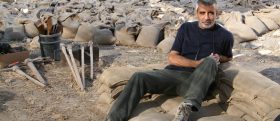
I am helping clean what seemed a possible differentiation in the color of a plastered mud-brick wall.

By: Mehrnoush Soroush, 2012 Heritage Fellow

In the summer of 2012, I received an ASOR fellowship to join a field project in central Turkey, in the region of Cappadocia. Elsewhere, I described my immense happiness about receiving the fellowship and the invaluable experiences I gained in the field. Here, I would like to write about the significance of the ASOR summer fellowship for my professional career and the reasons I hope ASOR can sustain its support of students in the future through the generous donations of its supporters.

Like everybody else, I guess, I spent the fellowship to pay for my flight and ground transportation. As a general rule, the majority of field projects in the Near East provide basic accommodation and food, when you get there. But, finding financial support to pay for your flight is a big challenge for students. Field directors cannot spend the limited resources they have paying for inexperienced beginners. Several other available funding resources are given only to those who are advanced in their research and can develop a coherent research plan of their own. I applied for the ASOR summer fellowship because it supports beginners like me, with limited options, and enables them to take their first steps into the field. Continue reading

A Lasting Impact on My Head and Heart

Heather excavating a hippo jar

By: Heather Pillette, Asbury Seminary, 2012 Heritage Fellow

It was a huge honor and great blessing to be one of the recipients of the Heritage Fellowship last year.  I journeyed to the beautiful northern Beth-Shean Valley of Israel to participate in the final dig of a beloved tel: Tel Rehov.  It was an incredible journey and experience, one which would not have been possible without the Heritage Fellowship.

Tel Rehov was my first on-site experience in the field of archeology, and as a result I know it will not be my last!  Rehov has yielded great finds in its seasons of excavation: pottery vessels, seals, inscriptions, figurines and cult stands, the famous apiary, and Carbon 14 data from burnt grain.  This site has significantly contributed to many ongoing conversations and debates.  Finds like these, and experiences like mine, would not be possible without scholarships such as the Heritage Fellowship. Continue reading

Archaeology Students, the Academic Artists

Justin with Abdel Assez Farouk, Head Kuft and Reis on site.

By: Justin Yoo, 2011 Platt Fellow

I once heard it said about artists, that they essentially go through life as ‘beggars.’ Even when they are employed, they are always looking for their next job and meal. Sometimes as a graduate student in archaeology, I feel we students can relate to this notion.  We are beholden to the goodwill and munificence of universities, professors, the government, and family—and my own experience is that they all have helped finance, in some way fund, the essential education and training required to follow an academic dream that most would call nothing more than a fool’s errand. Continue reading

A Quadcopter over Tel Dan

By: Thomas Beyl, 2012 Heritage Fellow

This past summer I had the great honor of receiving an ASOR Heritage Fellowship, which allowed me to pursue my dream of using a remote controlled aircraft to do aerial photography on an excavation. In the fall of 2011 I was invited by Dr. David Ilan to return to Tel Dan as an area supervisor for the 2012 dig season. Unlike previous years, there were no funds available to cover housing or food expenses, which also meant I could not afford to do aerial photography. For the past six years I have flown and built several different RC aircraft but had yet to complete an aircraft that could be easily transported and used on excavations. So I applied for an ASOR Heritage Fellowship, and was initially informed that I was not chosen as an awardee. Continue reading

A Monumental Surprise in Turkey

Johnson_DylanBy: Dylan Johnson, 2012 Heritage Fellow

ASOR’s Heritage Fellowship afforded me, along with many other students with an interest in Near Eastern archaeology, the opportunity to participate in archaeological excavations throughout the Near East. This past summer, I worked at Tell Taʾyinat, a small site in the southwestern province of Hatay, Turkey, close to the Syrian border. Continue reading

Support Archaeology Students

AASOR66_plate121

Plate 121, Jerusalem, Church of the Holy Sepulchre

Haven’t given to ASOR’s March Fellowship Madness yet? We are giving away a copy of The Photographs of the American Palestine Exploration Society (AASOR v. 66) by Rachel Hallote, Felicity Cobbing, and Jeffrey Spurr to one of the donors to our fellowship fundraising drive!

Here’s a chance to support a good cause and get something in return! The book includes over 150 never-before published photographs of sites in the Middle East (including sites in Jerusalem, Jerash, and Baalbek) taken in 1875.

March Fellowship Madness is seeking to raise enough funding to allow us to award a record number of excavation fellowships this summer. These fellowships go to deserving students to defray the costs of excavating in the Near East, often meaning the difference between joining a field project or staying home! We are appealing to you for a gift of at least $25 to support this effort, and all money raised for March Fellowship Madness will go directly to supporting fellowships. Go here to give now. Donations are tax-deductible. Continue reading

Fulfilling my Dream

Johnson_KristenBy: Kristen Johnson, 2012 Heritage Fellow

As someone who has spent a large portion of their adult life studying the intricacies of the Hebrew Bible narrative, subscribing to Biblical Archaeology Review, and learning ancient dead languages like Biblical Hebrew, getting the opportunity to experience my studies tangibly in their natural habitat of Israel through an archaeological dig was always a dream. I had considered funding a dig on my own but after an expensive college and in the midst of a master’s program there was no choice but to devote my summers to the hard work of money making. However since I was fortunate enough to receive a scholarship from ASOR I was able to justify spending my summer fulfilling my dream of learning about archaeology and exploring my studies firsthand in Israel. Continue reading

A Wonderful Season

A Hopkins 6

Amanda and other excavators in the cave entrance

By: Amanda Hopkins, 2012 Heritage Fellow

I received financial assistance as a Heritage Fellowship recipient which helped me to purchase my plane ticket. In addition to this practical benefit, I was able to share my experiences through the ASOR blog. Now, as I reflect upon my earlier posts (First, Second, Third, and Last) I have various markers that show me how understanding is a journey of perspective. For example, when we were originally given permission to excavate the cave we imagined that it could be a wine cellar.  Now we realize that the depth and shape of the cave best lends itself to being a reservoir or cistern. Continue reading

ASOR Heritage Fellowship: Helping Students Achieve Their Aspirations

Boonstra_Steph

With some of the new friends while in Wadi Rum

By: Stephanie Boonstra, 2012 Heritage Fellow

Returning to Khirbat al-Mudayna as a square supervisor this past summer was a life-changing experience for me.  I was awarded the Heritage Fellowship thanks to the generous donors of ASOR, which allowed me to revisit the ancient Kingdom of Moab to supervise and excavate under the direction of Dr. P.M. Michèle Daviau. Continue reading

With ASOR’s Help No Need to Stowaway

By: Sara Rich, 2012 Platt Fellow, Mazotos Shipwreck Excavation, Cyprus

Last summer, I received a Platt Foundation Fellowship to return for the third season of the Mazotos Shipwreck Excavation in Cyprus. The 18-m long cargo vessel went down a few decades before the Kyrenia, during the Late Classical Period (mid-fourth c. BC). Previous years had exposed three lead anchor stocks and sections of preserved hull and keel wood at the bow. Last year, we were to start excavating the stern, and since ship timbers are an important part of my research, I was anxious to get back. However, at that point, I was in the third year of my PhD at the Katholieke Universiteit Leuven (Belgium) and “in between” funding opportunities. I am so grateful to have received one of the fellowships because, besides being a stowaway, there is no way that I would have been able to return to the project without it. Continue reading

ASOR Heritage Fellowship: The Beginning of a Grand Adventure

By: Nate Ramsayer, M.A. student in Hebrew Bible and Ancient Near East at Brandeis University, 2012 Heritage Fellow

Nate at the Giza Pyramids before the dig in Israel, living the dream.

My participation in fieldwork was entirely predicated upon receiving a Heritage Fellowship; it allowed me to buy a plane ticket to the Middle East. Had I not been granted an award, you’d find a much grumpier, much more naïve Hebrew Bible student still sitting at Logan Airport in Boston, probably with a cup asking for change, trying to figure how in the heck he’s gonna make it overseas in time for next summer’s season!

The financial help ASOR provides students is incalculable in its impact. Continue reading

Changing perceptions through fieldwork

Excavating a Middle Islamic barrel-vaulted room

By: Nicholas Ames, 2012 Platt Fellow

The first thing that struck me once the post-excavation haze wore off a few weeks after my return to the United States, was the sudden realization of the vast difference between “education” and “edification.” The classroom’s education provides the theoretical framework with which to situate my perception of the world, but through the context of labor, the act of archaeology provides an ephemeral emic understanding of the past, becoming a contextualized reification of the course-based educational experience. And with memories of the field still fresh in my mind, I found I was no longer content to confine my learning to a lecture hall listening to someone pontificate about the past. What I wanted was to go out and uncover it. Continue reading

The Platt Fellowship’s Impact

By: Andrew LoPinto, 2012 Platt Fellow

Being selected to receive the ASOR Platt Excavation Fellowship has profoundly impacted me and my career in numerous ways.  On a practical level, the support of the Platt Excavation Fellowship made it possible for me to join the staff of the Pennsylvania State University expedition to Mendes for the 2012 season by covering the cost of my airfare to Egypt.  For many students who have chosen to work in Egypt, the cost of airfare can limit or entirely exclude individuals from participation in field work.  When combined, airfare, room and board, ground transit, baggage fees, and other miscellaneous expenses to undertake field work in Egypt can cost thousands of dollars.  Mitigating even one of those factors can take a potential field season from being cost-prohibitive, to being possible.  Continue reading

The Platt Fellowship Changed My Life

By: Caroline Carter, 2012 Platt Fellow

In the summer of 2011, I attended my first archaeological excavation during the opening season of the Huqoq Excavation Project in Huqoq, Israel under the direction of Professor Jodi Magness of the University of North Carolina at Chapel Hill and the Israel Antiquities Authority. I had not planned on returning in 2012, due to finances, nevertheless I reapplied for the project as well as a few fellowships just to see what would happen.

A month later, I received the email from ASOR notifying me that I was a recipient of the 2012 Platt Fellowship to attend my second season at Huqoq. It is a moment that I will never forget- Continue reading

Finally underway at Zincirli Höyük, Turkey!

J SkornikBy: Jordan Skornik, University of Chicago Divinity School

After a later-than-usual start due to Ramadan, the 7th season of the Neubauer Expedition to Zincirli (ancient Sam’al), an archaeological project of the University of Chicago’s Oriental Institute, began in earnest. Digging officially commenced at dawn on Saturday, August 25, and with only one week under our belts, there was already much to be excited about. Thanks to the Heritage Fellowship, I was able to experience it firsthand. Continue reading

Wrapping up at Tall al-Umayri

By: Amanda Hopkins, 2012 Heritage Fellow
Read Amanda’s earlier posts here (1), here (2), and here (3).

A Hopkins 6

Amanda and other excavators in the cave entrance

Week Four and the end of this year’s dig:

As we continue our digging something very exciting happens- a white, hollow and crumbly residue is found clinging to the chisel marks. This is definitely plaster! The chiseling and plaster can be found on the ceiling and sides of the cave. Further chiseling is also found when looking at the natural dissolution features that trail off from the SE and Southern quadrants of the cave. One can clearly see how the natural fissures in the rock have been humanly manipulated into channels that bend upward and toward the surface of the earth. All this plaster and chiseling suggest that the cave had been manipulated into a cistern. Continue reading

Summer discoveries at Khirbet Summeily

T RaymondBy: Tiffany Raymond, 2012 Heritage Fellow

This summer I was able to take part in the excavations at Khirbet Summeily due to the fact that ASOR awarded me a Heritage Fellowship, and I am very grateful to them for this. Khirbet Summeily is an Iron Age village site on the edge of the Negev Desert, and is believed to be a border site between ancient Philistia and Judah. The site is being excavated in association with the Tel-Hesi Joint Archaeological Project, and is directed by James. W. Hardin and Jeffery A. Blake. Typical artifacts at the site are loom weights, spindle whorls, mudbricks, beads, and pottery galore! Some of the rarer artifacts that we found were scarabs with Egyptian hieroglyphics, and figurines. Continue reading

Heritage Fellow’s Experience at Tel Akko

S Edwards By: Shane Edwards, Claremont Graduate University, 2012 Heritage Fellow

I just returned home from a wonderful experience on an archaeological excavation thanks to an ASOR Fellowship. The monies helped fund the four weeks I spent at the Akko tel located near the old city of Akko, Israel. This is my first opportunity to participate on a dig and it has given me a perspective that will aid with my religious studies research. Continue reading

Scooping Frogs and Excavating Statues in Turkey

By: Emily Coate, 2012 Heritage Fellow

The generosity of those behind the ASOR Heritage Fellowship afforded me my first opportunity to dig at a Near Eastern site. I participated in the excavations at Tell Tayinat, a settlement occupied during the Early Bronze and Iron Ages located in southern Turkey near the Syrian border. You may have heard the name in the news recently, owing to the discovery of a couple impressive statues this season. Particularly noteworthy is the head and torso of King Suppiluliuma, with a Hieroglyphic Luwian inscription across his back. Continue reading

Excavating Under the Egyptian Sun

A LoPintoBy: Andrew LoPinto, 2012 Platt Fellow

After a long and tiring journey, which consisted of a flight from Chicago to New York, a nine-hour layover in New York, a flight from New York to Frankfurt, Germany, a three hour layover in Frankfurt, a flight from Frankfurt to Cairo, an over-night stay in Cairo (the flight got in rather late), and a three hour drive…we finally arrived at Mendes!  Do not get me wrong, the flights were smooth and the company of the other expedition members made the trip much more tolerable than had I been alone, but in total, I was awake and on the move from 8:00am Monday morning until 8:00pm Tuesday night, and that does not include the over-night in Cairo nor the drive to Mendes. Continue reading