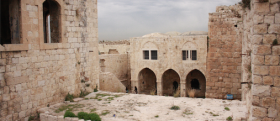


The capitol of the Babylonian empire, one of the wonders of the ancient world, has fallen on hard times. “If we don’t do something, in the next 10 years it will disappear completely,” says Thierry Grandin, a consultant to the World Monuments Fund overseeing workmen erecting wooden scaffolding to stabilize the 2,600-year-old north wall.
The Indus or Harappan Civilization was one of the greatest societies in the ancient world. Contemporary with Ancient Egypt and Mesopotamia, it was the largest of the three. Yet, between 3900 and 3000 years ago, the cities crumbled and the people moved away, now scientists believe climate change was to blame for its decline.
WorldMap is an open source web mapping system created at Harvard which allows researchers to create and share interactive maps, incorporating any type of information that can be mapped. One even shows hail storms recorded during China’s Yuan dynasty. Check out this map that shows the Medieval and Phoenician ports of Cyprus.
A team of archaeologists from a Texas theological seminary and the University of Cyprus is hoping to reveal the ordinary domestic lives of Cyprus’ early Christians in a new dig at Kourion (Curium) which was destroyed by a series of earthquakes around 365 AD.
Archaeological excavations have provided the first substantiation that a farmland estate in Sicily boasts a history which reaches back over a thousand years. Numerous finds demonstrate the continuous use of the land complex as a nexus of settlement and economic and religious life between the 5th and 16th century.
An altar and a stela estimated to date from as early as 800 B.C., from the Olmec pre-classic period, were found at the Chalcatzingo archaeological site in the central state of Morelos, Mexico’s National Institute of Anthropology and History, or INAH, said.
Archaeologists analyzing bones from the Lingjing site in China found that hominids at this site have already practiced sophisticated hunting techniques and subsistence strategies and may be quite familiar with the ecological and anatomical characteristics and nutritional values of the large-sized prey animals and can accordingly take different processing and handling strategies at the hunting site.
Researchers have identified what they say are the oldest-known musical instruments in the world. The flutes, made from bird bone and mammoth ivory, come from a cave in southern Germany which contains early evidence for the occupation of Europe by modern humans – Homo sapiens.
Two second-century Roman-era shipwrecks have been found in deep waters off Greece’s western coast, challenging the theory that ancient mariners stuck close to coastal routes for safety.
Shifts in exchange patterns provide a new perspective on the fall of inland Maya centers in Mesoamerica approximately 1,000 years ago. This major historical process, sometimes referred to as the “Maya collapse” has puzzled archaeologists, history buffs, and the news media for decades.
Archaeologists said Tuesday that they’ll ask the United Nations’ cultural agency to bestow world heritage status on Port Royal, the mostly submerged remains of a historic Jamaican port known as the “wickedest city on Earth” more than three centuries ago.
Vandals badly damaged a rare 1,600-year-old mosaic in the northern Israeli city of Tiberias that formed the floor of an ancient synagogue, smashing parts to rubble and scrawling graffiti, antiquity officials said Tuesday.
Excavations on Dunnyneil Island in Strangford Lough, Northern Ireland, have revealed a seventh century trading emporium frequented by merchants from as far afield as modern day Russia, Germany, Iceland and France.
A Jerusalem judge will announce whether he has decided to order the destruction of a burial box that could have held the bones of the brother of Jesus and an inscribed tablet that could have come from the First Temple. At a Jerusalem District Court hearing in April, Judge Aharon Farkash said he might exercise “the judgement of Solomon” and order both items to be destroyed.
Analysis carried out at the Australian Nuclear Science and Technology Organisation (ANSTO) on the skeletal remains of extinct megafauna is providing substantial proof that for about 2,000 years they infact shared the island with early humans before suddenly disappearing some time before the last ice age.
Archaeologists have found the earliest archaeological evidence of Jewish inhabitants in the region of modern-day Portugal in a surprising place–a Roman villa, on a piece of marble that may have been a tomb slab.