
The Siege of Masada: Piecing Together the Puzzle

§ January 18th, 2009 § Filed under Josephus, Masada § 158 Comments

Contributed by Jodi Magness, University of North Carolina at Chapel Hill

The ancient Jewish historian Flavius Josephus ended his monumental, multi-volume account of the First Jewish Revolt against Rome (the Jewish War) with the story of a mass suicide at Masada. According to Josephus, some 960 Jewish rebels holding out on top of Masada – the last stronghold to remain in Jewish hands after Jerusalem’s destruction in 70 C.E. – chose to commit suicide rather than surrender to the Roman troops besieging the fortress. It is because of Josephus’ story of the suicide, which includes a speech allegedly given by the rebel leader Eleazar ben Yair, that Masada became a symbol of Jewish resistance and the modern state of Israel.

However, Yigael Yadin’s 1963-65 excavations atop Masada failed to turn up conclusive evidence of the mass suicide. In fact, the archaeological evidence from Masada can be interpreted either as proving or disproving the mass suicide story, depending on how one evaluates Josephus’ reliability as an historian. For example, a group of inscribed potsherds (ostraca) found at Masada, including one bearing the name “ben Yair,” might be the lots drawn by the rebels prior to committing suicide or could simply be food ration tickets. Most likely, some rebels committed suicide while others were killed or surrendered to the Romans and were taken captive.

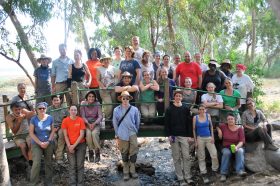
However, archaeology sheds valuable light on other aspects of the Roman siege of Masada, which was conducted in the winter-spring of 72/73 or 73/74 C.E. and probably lasted no longer than 2-3 months. The Roman siege works, including eight camps that housed approximately 8000 troops and a circumvallation (siege) wall, still are clearly visible encircling the base of the mountain. In June-July 1995, I was privileged to co-direct excavations in the Roman siege works at Masada, together with Professor Gideon Foerster (Hebrew University of Jerusalem), Dr. Haim Goldfus (Ben-Gurion University of the Negev), and Mr. Benny Arubas (Hebrew University of Jerusalem).

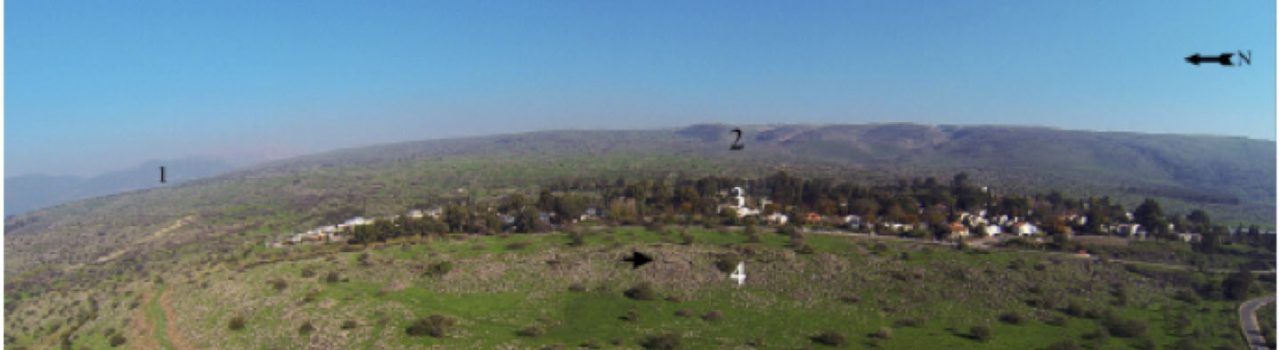
Photo of Camp F, taken from the top of Masada (photo by Jodi Magness).

Photo of Camp F, taken from the top of Masada (photo by Jodi Magness).

We focused much of our attention on Camp F, which is located on the northwest side of the mountain and housed about half of the Tenth Legion (with the other half in Camp B at the eastern foot of Masada). Our excavations brought to light low stone walls over which the Roman troops pitched leather tents. The floors of the tent units were covered with broken potsherds; altogether we recovered 240 kilograms (about 530 pounds) of pottery. The overwhelming majority of the pottery belongs to local types of storage jars, a finding that sheds light on the provisioning of the Roman troops during the siege. Because Masada is in the desert, supplies (mainly food and water) likely were brought in skins, bags, and woven baskets from other parts of the country, transported overland on pack animals or on small boats across the Dead Sea. Upon reaching the camps at Masada, the supplies were emptied into large ceramic jars for storage. The jars protected the contents from dampness, insects, and vermin. Most of the soldiers probably prepared and consumed their food using utensils in their individual mess-kits. However, the commander seems to have dined in style, judging from delicately painted bowls with eggshell thin walls found in his tent unit, which were imported from nearby Nabataea (southeast of the Dead Sea).

For me archaeology is not a means of validating (or negating) personal faith and beliefs. Instead it is a means of recovering and understanding the past, often one potsherd at a time, as in the case of Masada. These potsherds are pieces of a puzzle which enable us to reconstruct part of a picture that was otherwise lost.

158 Responses to “The Siege of Masada: Piecing Together the Puzzle”

  • Geoff Hudson says:

    THE DEATH OF AGRIPPA (Ant.20.8.10b)

    10b.”Ananus sent priests to fall upon the king’s soldiers. Those priests that were sent destroyed both Agrippa, and those that were his soldiers also.”

    This story appears in War 2.17.9:
    “But on the next day Agrippa, was caught where had had concealed himself in an aqueduct; he was slain.”

    Agrippa’s soldiers likewise were all killed (War 2.17.10):
    “but as soon as they had all laid down their shields and their swords, and were going away, Eleazar’s men (priests) attacked them, and encompassed them round, and slew them.”

    The text makes-out that the “Jewish” soldiers were allowed freedom. Roman soldiers remaining were fabricated. All the soldiers were probably Idumean.

  • Geoff Hudson says:

    Agrippa building a large dining room in the royal palace at Jerusalem was a ridiculous story to make believe Agrippa was still alive. The whole of Ant 20.8.11 is fabrication.

  • Geoff Hudson says:

    THE DEATH OF JAMES (Ant 20.9.1)

    1.”And now Caesar upon hearing the death of Agrippa, came on the road to Judea, as commander of the Roman army. But Ananus, TOOK the high priesthood. He thought he had now a proper opportunity to exercise his authority; so he assembled the sanhedrim of judges, and brought before them the son of Judas, whose name was James; and when he had formed an accusation against him of treason, he delivered him to be stoned; but some of his prophets went to meet Nero, as he was upon his journey from Alexandria, and informed him.”

    James was put on trial for treason. He had gone with Agrippa and Simon to Nero. We have here the basis of the trial of Jesus. Simon, the other son of Judas, was not a pacifist.

  • Geoff Hudson says:

    NERO CLEANS-UP (Ant 20.8.1-7)

    “But some of his prophets went to meet Nero, as he was upon his journey from Alexandria, and informed him. Whereupon Nero wrote in anger to Ananus, and threatened that he would bring him to punishment for what he had done. Now as soon as Nero was come to Judea, he used all his endeavours that the country might be kept in peace, and this by destroying many of the priests. Ananus had been a hoarder up of money. He had taken away the tithes that belonged to the prophets by right. So Nero brought all those priests who seemed to him to be most plainly worthy of death, and ordered them to be put to death accordingly. He gave the prophets a largess of corn, and distributed oil among them. He gave the prophets leave to collect the tithes. If any one of them did labour for a single hour, they received their pay immediately. He did not obstruct them when they desired that the city might be paved with white stone.”

    This was a time of liberation. Hence the celebratory coins of the four or five years of “the revolt”.

  • Eve Smith says:

    Hey! I am in high-school and am researching Masada for a project. I went there last june with my church on a trip to Israel. I was wondering if any of you knew how long the stores of food would have sustained a group as large as 960 people? I cant seem to locate it and you seem to be very knowledgeable in this field.

  • Geoff Hudson says:

    The fortress had previously been occupied by Agrippa I, not by Romans as in the writings attributed to Josephus. It was well kept with plenty of supplies for what was probably a small army. “Manaham” (supposedly one of the sons of Judas), found plenty of supplies when he “retired” to Masada. He apparently, simply “broke open” “king Herod’s” armoury. Now we are led to believe this was Herod the Great’s armoury which would have contained rusty old weapons. In fact, it was king Herod Agrippa’s armoury, full of the latest weapons. The priest’s led by Ananus (Manahem) had somehow overcome the guards and entered Masada.

  • Geoff Hudson says:

    The Flavian editors were were up to telling all sorts of lies making up their history as they went along. They lifted bits of history from here there and everywhere. Then they adpapted them for their own purposes.

  • John says:

    Dr. Magness states: “For me archaeology is not a means of validating (or negating) personal faith and beliefs.”

    In light of this statement, it would be interesting to know whether Dr. Magness intends to remain a member of the Society of Biblical Literature (at which she has played such a prominent role), or if she intends to follow Dr. Hendel in resigning from that organization. See Dr. Hendel’s explanation here:

    http://www.bib-arch.org/bar/article.asp?PubID=BSBA&Volume=36&Issue=04&ArticleID=09&Page=0&UserID=0&

    Furthermore, how does she feel about Dr. Hendel’s demand that SBL resign from the American Council of Learned Societies? See his comment (# 59) here:

    http://www.sbl-site.org/membership/farewell.aspx

  • Leave a Reply