Archaeology Students, the Academic Artists

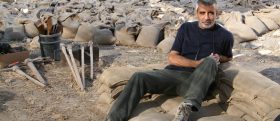
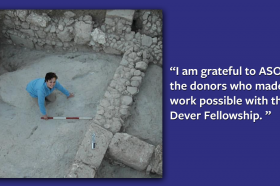
Justin with Abdel Assez Farouk, Head Kuft and Reis on site.

By: Justin Yoo, 2011 Platt Fellow

I once heard it said about artists, that they essentially go through life as ‘beggars.’ Even when they are employed, they are always looking for their next job and meal. Sometimes as a graduate student in archaeology, I feel we students can relate to this notion.  We are beholden to the goodwill and munificence of universities, professors, the government, and family—and my own experience is that they all have helped finance, in some way fund, the essential education and training required to follow an academic dream that most would call nothing more than a fool’s errand. Continue reading

With ASOR’s Help No Need to Stowaway

By: Sara Rich, 2012 Platt Fellow, Mazotos Shipwreck Excavation, Cyprus

Last summer, I received a Platt Foundation Fellowship to return for the third season of the Mazotos Shipwreck Excavation in Cyprus. The 18-m long cargo vessel went down a few decades before the Kyrenia, during the Late Classical Period (mid-fourth c. BC). Previous years had exposed three lead anchor stocks and sections of preserved hull and keel wood at the bow. Last year, we were to start excavating the stern, and since ship timbers are an important part of my research, I was anxious to get back. However, at that point, I was in the third year of my PhD at the Katholieke Universiteit Leuven (Belgium) and “in between” funding opportunities. I am so grateful to have received one of the fellowships because, besides being a stowaway, there is no way that I would have been able to return to the project without it. Continue reading

Changing perceptions through fieldwork

Excavating a Middle Islamic barrel-vaulted room

By: Nicholas Ames, 2012 Platt Fellow

The first thing that struck me once the post-excavation haze wore off a few weeks after my return to the United States, was the sudden realization of the vast difference between “education” and “edification.” The classroom’s education provides the theoretical framework with which to situate my perception of the world, but through the context of labor, the act of archaeology provides an ephemeral emic understanding of the past, becoming a contextualized reification of the course-based educational experience. And with memories of the field still fresh in my mind, I found I was no longer content to confine my learning to a lecture hall listening to someone pontificate about the past. What I wanted was to go out and uncover it. Continue reading

The Platt Fellowship’s Impact

By: Andrew LoPinto, 2012 Platt Fellow

Being selected to receive the ASOR Platt Excavation Fellowship has profoundly impacted me and my career in numerous ways.  On a practical level, the support of the Platt Excavation Fellowship made it possible for me to join the staff of the Pennsylvania State University expedition to Mendes for the 2012 season by covering the cost of my airfare to Egypt.  For many students who have chosen to work in Egypt, the cost of airfare can limit or entirely exclude individuals from participation in field work.  When combined, airfare, room and board, ground transit, baggage fees, and other miscellaneous expenses to undertake field work in Egypt can cost thousands of dollars.  Mitigating even one of those factors can take a potential field season from being cost-prohibitive, to being possible.  Continue reading

The Platt Fellowship Changed My Life

By: Caroline Carter, 2012 Platt Fellow

In the summer of 2011, I attended my first archaeological excavation during the opening season of the Huqoq Excavation Project in Huqoq, Israel under the direction of Professor Jodi Magness of the University of North Carolina at Chapel Hill and the Israel Antiquities Authority. I had not planned on returning in 2012, due to finances, nevertheless I reapplied for the project as well as a few fellowships just to see what would happen.

A month later, I received the email from ASOR notifying me that I was a recipient of the 2012 Platt Fellowship to attend my second season at Huqoq. It is a moment that I will never forget- Continue reading

Excavating Under the Egyptian Sun

A LoPintoBy: Andrew LoPinto, 2012 Platt Fellow

After a long and tiring journey, which consisted of a flight from Chicago to New York, a nine-hour layover in New York, a flight from New York to Frankfurt, Germany, a three hour layover in Frankfurt, a flight from Frankfurt to Cairo, an over-night stay in Cairo (the flight got in rather late), and a three hour drive…we finally arrived at Mendes!  Do not get me wrong, the flights were smooth and the company of the other expedition members made the trip much more tolerable than had I been alone, but in total, I was awake and on the move from 8:00am Monday morning until 8:00pm Tuesday night, and that does not include the over-night in Cairo nor the drive to Mendes. Continue reading

History (and Microdebris) Uncovered at Dhiban

Excavating a Middle Islamic barrel-vaulted room

By: Nicholas Ames, 2012 Platt Fellow

Waking up at 4:00am is difficult no matter where you are in the world. But somehow, waking up in Jordan for the first time made it just a little bit easier.

Breakfast at 4:30am and troweling by 6:00am, it is a schedule regimented by environmental and social concerns of labouring outdoors in a culturally foreign country – which is exactly what field archaeology is. Despite this early schedule, my overall experience excavating with the Dhiban Excavation and Development Project (DEDP) left me craving for much more – more time spent in the field as well as need for a much greater understanding of the regional and methodological history of archaeology and excavation in the Near East. Continue reading

Platt Fellow’s Close Encounter with a Camel


By: Patrick Clark, 2012 Platt Fellow

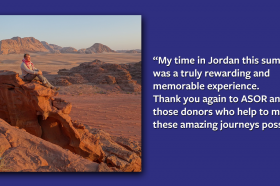
This summer I had the privilege of receiving the Platt Fellowship.  This generous grant enabled me to join Dr. Andrew M. Smith II for a second incredible field season at Bir Madhkur.  In my photo I am sitting on a boulder in a wadi, recording a Bedouin camp built on a Roman-era wadi terrace.  My friend, and our guide, Musa yells “Shoof, Ghadeer (my Bedouin name)!”  I look up. A camel is walking up to me.  Continue reading

Despite Early Mornings Platt Fellow Happy to be Excavating

By: Ted Gold, University of Chicago, 2012 Platt Fellow

To begin with, a little background on what the Platt Fellowship meant to me: I’d been doing some work for Professor Yorke M. Rowan over the course of the winter and spring quarters of my third year at college, and he was kind enough to inform me that he was running a dig at the Continue reading

Platt Fellow Reflects on Mosaic Discovery

Huqoq mosaic with female face and inscription. Photo by Jim Haberman.

By: Caroline Carter, 2012 Platt Fellow

I ended my last blog saying, “It’s not everyday that you get to protect a 500+-year-old site from frantic farm animals.” As the month continued and new discoveries were made at Huqoq, Israel, I also came to find out that it’s not every day that you can say, “WE FOUND A MOSAIC FLOOR IN THE ANCIENT SYNAGOGUE!!!!” Continue reading

Platt Fellow Uncovers 19th Century Excavation in Bronze Age Site

Carrie excavating in the trench North of Building 1 at Maroni-Tsaroukkas. Photo: Sturt Manning.

By: Carrie Fulton, 2012 Platt Fellow

In 1897, an expedition by the British Museum to Cyprus opened a number of pits in search of tombs in the lower Maroni Valley at Tsaroukkas, removing many objects of interest and backfilling the pits they had created.  Fast-forward about 115 years later and thanks to the generous funding from the Platt Fellowship through ASOR I was able to join the Kalavasos and Maroni Built Environments (KAMBE) Project for a month of excavation.  The project, led by Dr. Sturt Manning (Cornell University) and Dr. Kevin Fisher (University of Arkansas), has focused on using geophysical survey to elucidate patterns in the Late Bronze Age occupation for this region of Cyprus, and this season they added excavation to ground truth their findings.  I would like to take you through one of the trenches I worked on as I learned about stratigraphy and site formation processes.

Continue reading

Several centuries of glass in one summer

Carrie Swan excavating glass

By: Carrie Swan, The Joukowsky Institute for Archaeology and the Ancient World, Brown University, 2012 Platt Fellow

As a glass artifact specialist, my research is not limited to a particular time period or geographic region, so I am able to study material from a range of times and places. It’s incredibly interesting and rewarding to view material culture over a long chronological sequence, and to study the particular ways in which glass was produced and used within various regions and by different cultures. This summer I’ve been fortunate enough to work with two different projects, studying the glass assemblages unearthed during the excavation of Horbat Huqoq in Israel and Hisn al-Tinat in Turkey.

Huqoq is a Jewish village located in the Galilee region of Israel, just west of Lake Kinneret and within the area of ancient Migdal, Capernaum, and other villages made famous by the life of Jesus. The site dates primarily to the Roman-Early Byzantine period, but our excavation project actually has three main goals: 1) to study the ancient village, 2) to study the synagogue of the ancient village, and 3) to study the “modern” Arab-Palestinian village of Yakuk that was built on top of the ancient village but abandoned in 1948 and bulldozed in the 1960s. Continue reading

Platt Fellow Experiences New Cultural Worlds

By: Mariana Garcia de la Noceda, 2012 Platt Fellow

The Middle East is one of the few places in the world where you can be digging in your square, just minding your own business, while there are camels and donkeys walking around the site sniffing the picks and shovels. It’s also one of the few places in the world where people of all faiths, nations and languages can be found working together in the same field for the same reasons. This has been my experience in Tall Jalul, in central Jordan. In my square, which we nicknamed the United Nations, no two people are from the same country, or have the same native tongue. It’s a mix of color and accents that I have never experienced before. And it’s one of the most beautiful experiences I’ve ever had, even if we have to get up at 4 o’clock in the morning.

Continue reading

ASOR Funding Helps Student Participate in Huqoq Excavation

By: Caroline Carter, 2012 Platt Fellow

I will never forget the moment I read the email from ASOR notifying me that I was a recipient of the 2012 Platt Scholarship. I was in class, and I immediately burst into tears of joy. I am a rising junior, double majoring in Classical Archaeology and Ancient Mediterranean Religions at the University of North Carolina at Chapel Hill and this is the first monetary reward I have received. Not only have the donors helped fund my second season at Huqoq, Israel, but they have given me so much happiness, encouragement, and self-confidence that I needed to keep up with all that is required in this field of study.

Last year I attended my first archaeological excavation during the opening season at Huqoq, Israel under direction of Dr. Jodi Magness of UNC-CH. Because of finances, I had not planned on returning, but I was encouraged so much to reapply that I finally did at the very last moment of the application deadline. However, I am so thankful that I came back, despite the hectic scrambling to turn everything in on time.

Continue reading

Platt Fellow at the Mazotos Shipwreck Excavation, Cyprus

By: Sara Rich, University of Leuven, 2012 Platt Fellow

I’d like to tell you about my best day in the field – ever. Honestly, between the promise of keel wood and the dolphins, there isn’t even a close runner up.

This morning the waters off the south-central coast of Cyprus were calm despite the storm that was supposed to be blowing in from the west. This was already a good sign. Bad weather and transportation issues meant that my dive yesterday had to be canceled. The past couple of days we’ve had some technical problems with the “rib” (acronym for “rigid inflatable boat”) that takes us out to the site every day, where the support vessel, Marilena, is stationed directly above the wreck. So in lieu of the rib, we’d been hitching rides out to sea and back on local fishing boats. This was great fun, but rather time-consuming, as you can imagine. Well this morning by 6am that problem had been resolved, so we arrived on site as planned by 7am via not one, but two fully-functioning ribs.

Continue reading

ASOR Platt Fellowship: Supporting Student Research at Çatalhöyük

Thanks to ASOR, I am now afraid of dogs.

I should clarify: I am afraid of dogs because I was chased down by vicious, barking, salivating, mastiff-sized köpekler in central Turkey. And I was only there because ASOR selected me as one of the recipients for their Platt fellowship.

I applied for ASOR’s generous stipend program so that I could participate in excavations at Çatalhöyük, a Neolithic-period archaeological site in central Turkey.  I wanted to understand how the reasoning that archaeologists do in the field gets translated into how they write later— Continue reading

ASOR Fellow excavates at Tel Burna

My participation in the 2011 excavation season at Tel Burna, made possible through the support of the Platt Fellowship from the American Schools of Oriental Research, helped further my research on the socio-political history of the Shephelah. During the Iron Age, Tel Burna was situated in the borderlands of Judah and Philistia, and my work at Tel Burna gave me a better sense for the material culture of this liminal area during the late Iron Age. Furthermore, the excavation allowed me to carefully examine evidence for the transitions that occurred between the late Iron Age to the Persian Period. All of these factors directly contribute to my goal of understanding the cultural and historical identity of Tel Burna against the broader socio-political background of the inner coastal plain in the first millennium BCE.

Continue reading

Help Shape A Person’s Career with ASOR’s March Fellowship Madness!

Today we are proud to announce the launch of an exciting new campaign to raise money for excavation fellowships! Every year ASOR gives out around 30 Platt and Heritage Fellowships to deserving students and junior scholars to defray the costs of conducting fieldwork in the Near East. This year the number of applicants for these fellowships more than doubled to 179!

While we have the funding to send 33 of our applicants to the field, we didn’t want to waste this opportunity to fund more deserving students. So, for the first time, we are conducting a public fundraising drive to raise money for 20 additional fellowships.

Can you donate $25 to help us send these students to the field?

Continue reading

ASOR Fellow Explores Ashkelon

Thanks to the generous funding from an ASOR Platt Excavation Fellowship, I was able to join the The Leon Levy Expedition to Ashkelon for the 2011 excavation season under the direction of Dr. Daniel Master. There I served as an Assistant Square Supervisor in the excavations of the Severan-period odeion, led by Dr. Tracy Hoffman. This was my first experience in the large-scale excavations of a monumental Roman building and it provided me with invaluable training for my studies of Classical Archaeology.

Continue reading

ASOR Platt Fellow explores Ottoman water system

Due in part to the Platt Fellowship offered by ASOR, I was able to participate in the Tel Akko Total Archaeology Project and Field School. This unique field school combines excavation, survey, geographic information systems (GIS), conservation, and public archaeology in order to immerse students into a holistic archaeological experience. The Tel Akko project and excavations are co-directed by Professors Dr. Ann E. Killebrew of the Pennsylvania State University and Michal Artzy of the University of Haifa. Tel Akko and the adjacent Old Acre are located on a natural harbor along the Mediterranean Sea in northern Israel. The city has served as a major maritime center and crossroads between east and west throughout its history. Excavations on the tel have revealed evidence of Canaanite, “Sea Peoples”, Phoenician, Persian, Greek, and Hellenistic cultures. The UNESCO World Heritage site of Acre boasts the best preserved Crusader city in the world, today located beneath the 18th and 19th century Ottoman town.

Continue reading